
Search is currently unavailable. To use search functionality, please accept cookies in your preferences.
Meet Transgender Thru-Hiker Lyla “Sugar” Harrod
Preparing for a historic Appalachian Trail FKT attempt.
9 minutos leer
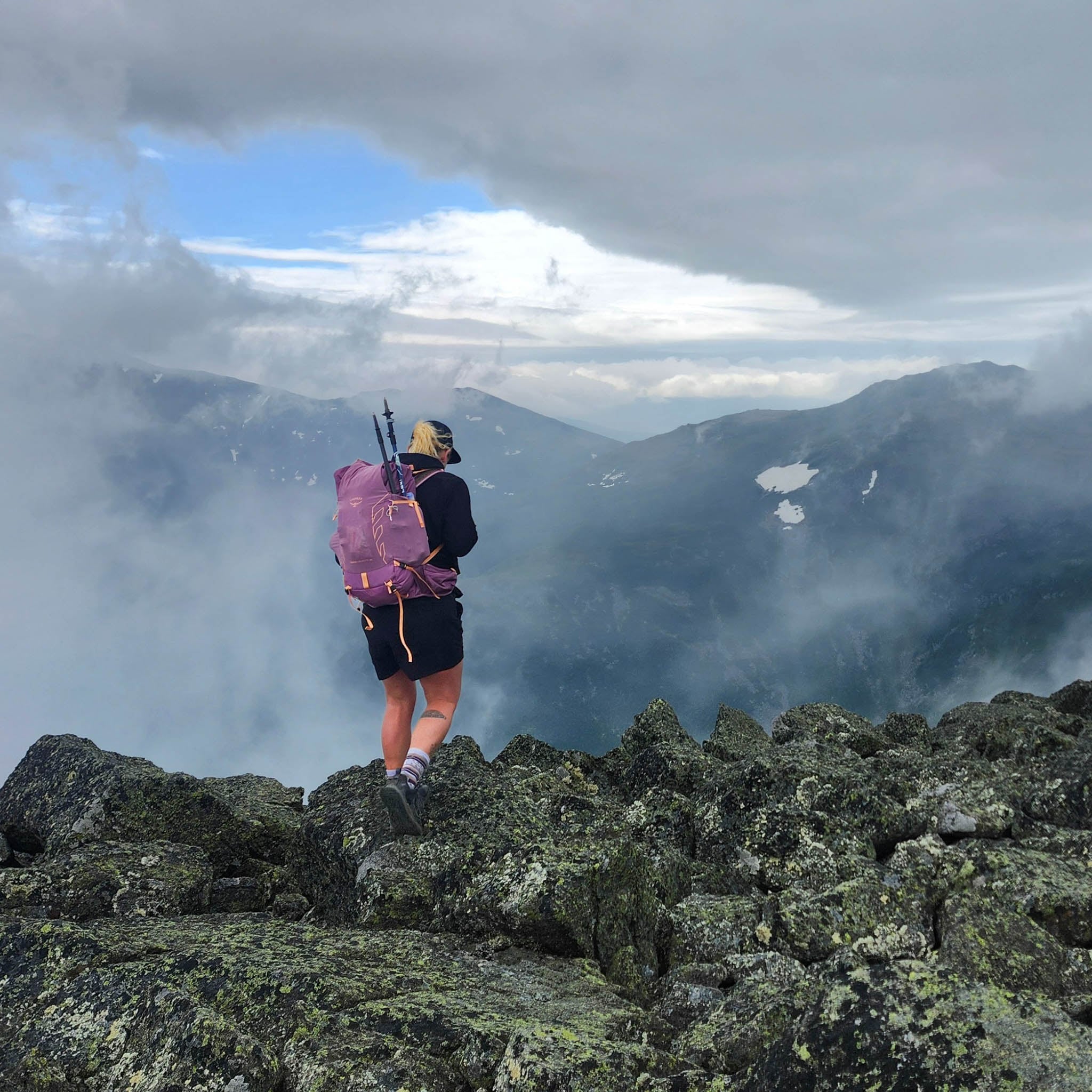
Lyla “Sugar” Harrod
Jun 20, 2025
Read the Exciting Update to this Story(Se abre en una nueva ventana)
I’m a sober, queer, transgender woman and professional long distance hiker. In addition to being the first known transgender woman to complete the Triple Crown of hiking, I hold the women’s unsupported speed record for New Hampshire’s 48 4,000-foot mountains. This summer, I’ll take on my biggest challenge yet when I attempt to break the women’s self-supported speed record of the Appalachian Trail, which currently stands at 54 days.
Why do I share my story?
While researching the Appalachian Trail before my thru-hike in 2021, Googling terms like “transgender thru-hiker” and “Appalachian Trail trans hiker” got practically no results. I had hoped to find trans people’s stories of thru-hiking, and maybe some insights into the specialized challenges they faced. Instead, I left feeling isolated and wondering if trans people hadn’t ever thru-hiked, or much more likely, if trans people hadn’t felt safe enough to share their stories publicly for fear of transphobia and negative attention. At that point I decided that, even though I had almost never used social media in the prior decade, that I would try to put myself and my story out there for other trans and queer people, so they know they aren’t alone.

Over four years and 14,000 miles later, I still strive to make myself accessible to queer and trans hikers, and created a free mentoring program for first time queer and trans hikers called Trail QTs(Se abre en una nueva ventana). I’ve formed so many friendships with other queer and trans hikers as a result of putting myself out there, so I absolutely benefit from my willingness to share my story publicly too!
Why go for the Appalachian Trail speed record?
Now more than ever, the world is a dangerous place for trans people. Hundreds of anti-trans laws are put into effect each year, restricting our access to lifesaving, gender-affirming care and in many states making it illegal for us to use the proper public restrooms, which puts us at extreme risk of violence and harassment.
Trans athletes are being barred from competition using false science and fear tactics. As a hiker, the speed record or “Fastest Known Time” (FKT), has become the primary form of competition within our sport. Thankfully, trans athletes are currently allowed to compete in the correct gender category. My hope is to use the platform that comes with attempting a high profile FKT to create a dialogue in our community centered on inclusion in the outdoors and how we can protect trans people’s rights within the hiking community even as the country as a whole moves towards outlawing trans people’s existence.

What makes an Fastest Known Time attempt “self-supported”?
Fastest Known Times are catalogued and validated via FastestKnownTime.com(Se abre en una nueva ventana) using a system of primarily volunteers to confirm people’s attempts as successful or not by looking over GPS tracks of the athlete’s attempt and reading through their description of the effort to make sure the guidelines are followed. The guidelines depend on the type of attempt, which could be “Supported”, “Self-Supported” or “Unsupported”.
For context, a “Supported” effort means you can get as much help as you want throughout the effort, so people often will have a support crew taking care of their needs and transporting their gear so they can focus on moving as quickly as possible. An “Unsupported” effort involves carrying everything you need for the entire effort (except water) from the beginning with no stopping at stores, hostels etc.
I’ll be following the “Self-Supported” style for this effort. A “Self-Supported” FKT attempt means that the athlete must carry all of their own gear and is responsible for their own food and water. Any time the athlete needs to resupply, they must walk to the resupply point, whether it’s a grocery store to buy food, or a post office or hostel where they’ve sent a “resupply box”. They can’t accept any gifts or “trail magic” that are specifically meant for them.

In advance of my start date, I’ll mail food and supplies in boxes, which we call “resupply boxes” to accessible points along the trail. I determine where to send boxes based on how far they are from the previous and next resupply point. I’m hoping to carry no more than 3-4 days of food at any time so it could be between 120 and 200 miles between resupplies. I’ll supplement my diet with food I buy in towns I pass through. My body will need an ungodly amount of calories to power my efforts, so high-calorie foods like cheeseburgers and pizza are my go-to choices!
What will I carry on trail?
I hope to carry a base weight of just over eight pounds, not including food and water. The key to achieving such a low base weight is to choose lightweight gear, but more importantly, to only carry the barest minimum of what you need.
I will publish a full gear list in July closer to my start date, but for now I’ll share my “Big Three”. The Big Three are your pack, your shelter, and your sleep system. These are generally considered to be your most crucial pieces of gear.
Pack
Osprey Tempest Velocity 30(Se abre en una nueva ventana)
Weight: 2 pounds 2 ounces
This fastpack is tough, compact and has running vest style straps that keep my gear secure and not bouncing around even as I jog down trail with a full pack. The internal frame provides essential back support for those insanely long days and extended food carries.
Shelter
Gossamer Gear DCF Whisper
Weight: 10 ounces
New this year, the DCF Whisper is a tarp-like shelter that adds a mesh skirt to the bottom to serve as bug protection—a much needed feature on the Appalachian Trail! At the insanely light weight of 10 ounces, you won’t find a roomier shelter.
Sleep System
Enlightened Equipment Revelation 30 Degree Quilt
Weight: 1 pound 4 ounces
My go-to 30 degree quilt: I’ve carried it on the Arizona Trail, Appalachian Trail and Pacific Crest Trail. It’s synthetic so it will keep me warm even when it gets wet, and at 19 ounces it packs down well, which is important when your pack only holds 30 liters.
Gossamer Gear Torso Foam Pad - ⅜”
Weight: 3 ounces
In years past, I’ve used Gossamer Gear’s ⅛” Thinlight pads, but I usually ended up folding them upon themselves to make them slightly thicker to provide more comfort. This year, GG came out with a ⅜” pad that, while shorter than their ⅛” pads, provides triple the comfort for the parts of my body that matter most as a side sleeper: my hips and shoulders.

Follow along and support!
The best way to support my effort is to follow me on Instagram @seltzerskelter (Se abre en una nueva ventana)and be sure to like, comment and share! If you are able and would like to help fund my effort, please contribute to my GoFundMe(Se abre en una nueva ventana)!
Photo Credit: Lyla "Sugar" Harrod
Video player
Cargando...
Mi cesta
Your Cart ()
No tienes ningún artículo en tu carrito.
You may also like
Subtotal:
Subtotal after discount:
Cargando...