
Search is currently unavailable. To use search functionality, please accept cookies in your preferences.
Pushing my Limits on a Five-Day Trek Through Pakistan’s Karakoram Mountains
13 min read
Laura Kiniry
Aug 08, 2025
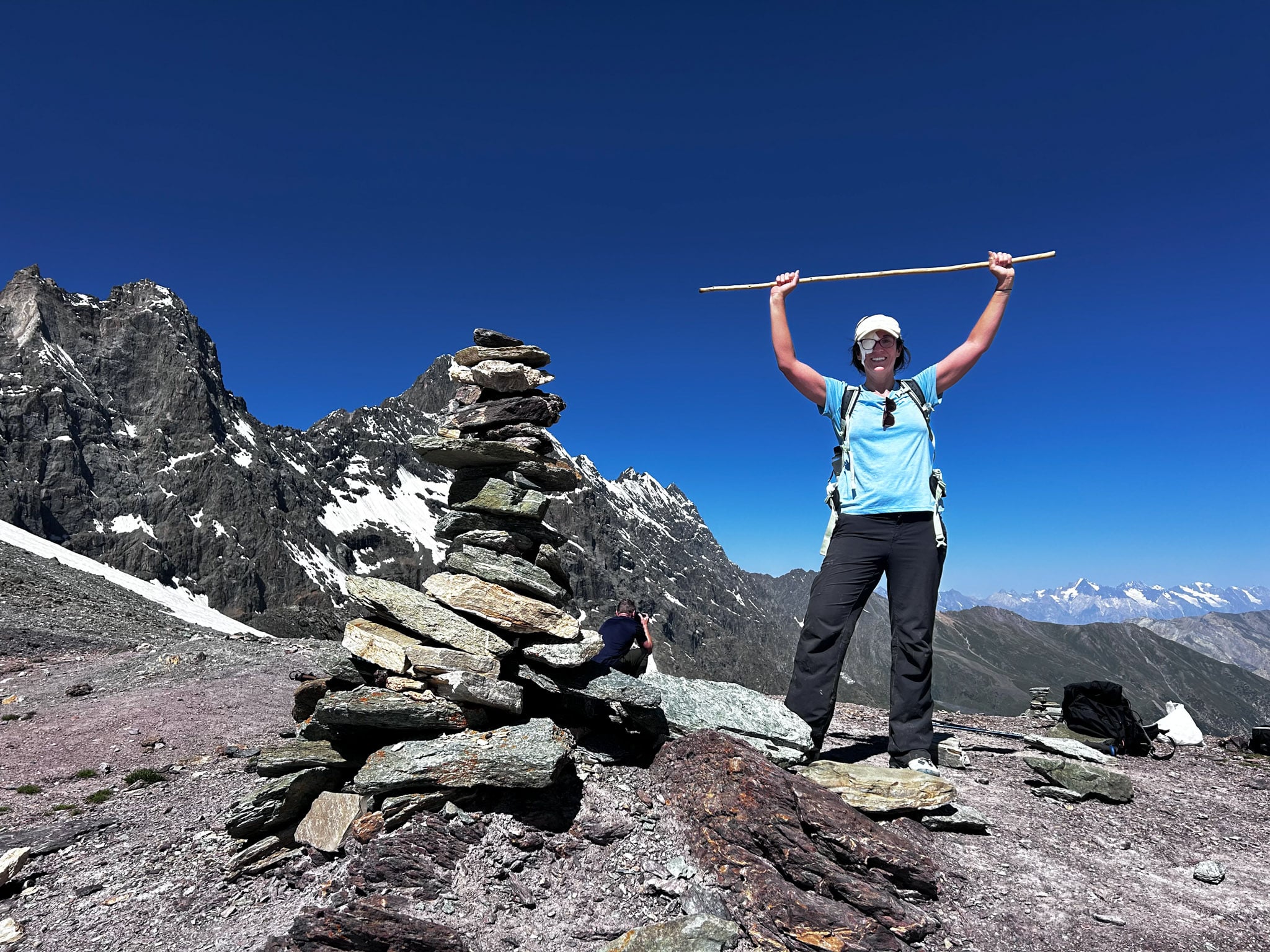
After four days of trekking we found ourselves standing atop Thallay La, a 15,715-foot-high pass in Pakistan’s Karakoram mountains. I took a deep breath and then soaked up the view. In the distance stretched a series of jagged, snow-dipped peaks adorned with lengthy glaciers, while down below, lush green pastures interspersed with winding streams and shepherd’s trails, and herds of sheep, cows, and yaks roamed. Our small group of eight hikers had set out with our guides and a couple of porters that early morning, climbing 2,034 feet in elevation up a steep rocky trail and crossing a large patch of snow to reach this point, our nearly 16,000-foot-high summit. But there was something major I hadn’t accounted for when we first departed from the Thallay Valley days earlier: I only had one working eye.
The Allure of the Karakoram
When I’d first learned of G Adventures’ Pakistan: Hike the Karakoram Mountains(Opens in a new window), a brand new 9-day trip combining a strenuous five-day trek through the world’s second tallest mountain range with a visit to Pakistan’s capital city, Islamabad, I knew it was for me. Several months earlier I’d climbed my highest mountain to date, Africa’s 19,341-foot-tall Mount Kilimanjaro, and the opportunity to further push myself with this latest tour was a no-brainer.
“[The Karakoram mountains] have been keepers of secrets for eons,” said my friend Saad Khan, who grew up in Karachi, Pakistan’s economic hub.

The over 300-mile-long chain of peaks spans the borders of Pakistan, China, and India—even crossing into Afghanistan and Tajikistan on its northwestern edge—and contains some of the world’s highest and most challenging summits. These include 28,251-foot-tall K2, the second tallest mountain on earth after Mt. Everest (which comes in at a whopping 29,032 feet). In addition, Pakistan is the only country in the world where its three tallest mountain ranges—the Karakoram, Himalayas, and Hindu Kush—meet, and its north is home to more glaciers than most any other area on the planet outside of its polar regions.
But to many people who don’t have a love of mountains, all tall peaks seem pretty much the same. “I hear you climbed Everest,” said several friends after I’d returned from summiting Kili(Opens in a new window) in February. While tackling “the roof of Africa” is an incredible feat, it’s one that’s much more manageable than undertaking the world’s fourteen “8,000ers” (peaks over 26,247 feet), all of which are located within the Himalayan and Karakoram mountain ranges and require rigorous mountaineering training, extensive planning, and unbelievable fitness. My latest goal was simply to test my own limits on high-elevation ridges formed by the same tectonic plates.
Setting Out
Our small group consisted of eight hikers, several of whom were from the U.S. and the U.K., as well as one Aussie and one Canadian. We ranged in age from our late 20s to early 70s and covered a mix of professions, including a travel specialist, a pediatrician, and an American teaching overseas in Taiwan. But one thing we all shared in common was a love of outdoor adventure.

After meeting in Islamabad, we boarded an Airblue flight to Skardu International Airport and set out in a trio of Toyota LandCruisers to our trek’s starting point: the Tallay Valley. This stunning landscape of sprawling meadows and rushing rivers is considered a hidden gem by locals—a bastion of ancient Silk Road history that’s largely off the radar of most travelers. It was the perfect introduction to northern Pakistan’s vast natural beauty. As we made our way past rivers of churning gray waters and along gravely foothills on a series of winding, narrow roads, the region’s jagged white-tufted peaks became more and more visible and brown slope-sides transformed into grassy hillsides.
A few weeks before I left for the trip, a friend asked me point-blank, “Why are you doing this?” He’d heard my stories of the stomach ailments I faced on Kilimanjaro’s summit night, and had his own reservations about Pakistan, a country that doesn’t always have the best PR. My response was immediate.
“Because I can,” I said.
That morning a few months earlier when I stood atop Uhuru Peak, Kili’s highest point, I felt a sense of peace and accomplishment unlike anything I had experienced in a long while. While I’m athletic, I’d put my body through the ringer that summit night. Weak and dehydrated, I relied on an inner strength that I didn’t know I had to propel me up that mountain, and although I found myself thinking, “I’m so unbelievably glad that’s over,” as we began our descent, by the time we’d reached camp that evening I was already contemplating the next hikes I would complete and what mountains I might climb.

Now here I was, on another adventure that I was hoping would challenge me like the first—both physically and mentally.
Our first couple of days consisted of easy climbs along shepherds’ trails, passing over alongside snowbanks and across fields dotted with wildflowers in bursts of purple, yellow and pink. We each trekked at our own speeds, often meeting up for water breaks before continuing on to our site of candy-colored tents arranged like scattered Skittles among the verdant valleys and craggy peaks. At night, we’d gather in our mess tent for plates of chapati bread and bowls of biryani and balay soup with homemade noodles, then retire to the sound of a rushing river before the 4:30 am wake-up of nature’s own alarm clock: the bleating of sheep and the grunting of yak hybrids as the sun lit the sky. Together with our guides and our 20-plus porters we were alone in our own little Shangri La, isolated in the wilderness and away from the constraints of everyday life.

After settling into camp on day two, several of us decided to head out on a short acclimatization hike. But as soon as we crossed the river, I felt a rush of nausea. “I think I’m going to sit the rest of this out,” I said, retiring to a nearby section of boulders while the others continued on. I watched them ascend and then suddenly, I was gagging and wretching, my stomach doing somersaults as I counted the minutes until I could return to my tent.
The following day was more of the same, with everything that I’d eaten previously coming right back up the higher we went in elevation. At the same time, I noticed a slight inflammation in my right eye. “This isn’t your week,” one of my fellow trekkers, Ross (aka Russ with an “o”), said to me, and I raised my brows and laughed. We were all battling our own light ailments (upset stomachs, shortness of breath…even a crisis or two of the mind) on the mountain—mine just happened to be hitting all at once.
When we awoke early on the fourth day to summit, my nausea had subsided but my right eye was red, irritated, and blurry (I’d learn later it was an infection resulting from a lost contact lens), and exposing it to any sort of light was extremely painful. I knew then that there was no chance of me reaching Thallay La pass without covering that eye and relying on my left one completely. So with help from our guides and a couple of my companions, I fashioned an eye patch from a strip of white gauze and some medical tape and we set out towards the ascent.
Carrying a trekking pole in one hand and a shepherd’s stick in the other, I climbed slowly upwards, navigating the steep and narrow trails with the help of our porters, Shahsid and Aslam. My depth perception was extremely limited and after one rocky path, I could feel myself falling into despair. “Was this really worth it?” I thought. “Seriously, what made me think this was ever my mountain to climb?”
Despite the ongoing battle in my head I kept moving my feet, one in front of the other. Soon enough our summit came into view, and after crossing a particularly large snowpatch I found myself facing a human-sized cairn marking the 15,715-foot-high pass. Once we were all at the top, we hugged high-fived each other and took a seemingly endless series of pics, and then stood silently at the top of Thallay La, reveling in the beauty of one of the most spectacular mountain landscapes on the planet.

The Takeaway of the Mountains
Merriam-Webster defines the word ‘obstacle’ as “something that impedes progress or achievement,” but not something that halts it completely. Here I was standing atop a nearly 16,000-foot-high summit that I’d reached wearing an eye-patch and on an empty stomach (my appetite hadn’t yet returned), exuberant with the fact that I’d accomplished what I’d set out to do.
On the fifth morning of our trek, I was able to remove the makeshift eye-patch and see well enough to tackle our last 16 miles, crossing precariously placed boulders that served as bridges across turbulent rivers, traversing slender cliffside pathways with sheer drops beside them, and walking along a seemingly endless roadside in the blazing sun. But when I finally reached our ending point at Shigar Fort in northern Pakistan’s Shigar Valley, I was tired, sore, and thirsty, yet smiling from ear-to-ear. Not only was there an orange Mirinda soda (our trip’s unofficial soft drink) awaiting me when I arrived, but an even sweeter reward was in knowing that in the face of adversity, I had found the mental and physical strength to keep moving forward.
And true to form, I’m already contemplating my next mountain challenge.
Photo Credit: Laura Kiniry
Loading...