
Search is currently unavailable. To use search functionality, please accept cookies in your preferences.
How Community Homestays Are Bringing Financial Independence To Newari Women
Inside the Kitchens Where Nepal's Women Are Reshaping Tourism
12 minutos leer
Feb 20, 2025
My motorcycle driver wove through the city’s traffic into the outskirts of town, and my thoughts drifted above the noise of the cars to the conversation I’d had with Aayusha a few days ago. She said that most people think of community tourism as rural tourism, but here I was, still in Kathmandu's orbit, heading to a three-night homestay.
Kirtipur, my destination, has a complicated relationship with tourism. Despite being just 6-7 kilometers from Kathmandu's center and rich in Newari culture, it has struggled to benefit from its location. Tourists come for short visits and then leave. The women of the community, who had traditionally worked in agriculture, are watching their economic opportunities shrink as farming declines in the increasingly urban area.
When Planeterra, one of Community Homestay Network (CHN)’s impact partners, approached them about creating an immersive cooking experience near Kathmandu, the women of Kirtipur had an idea: why not momos? Momos—Nepal's beloved dumplings filled with spiced meat or vegetables—are more than just street food here. In Newari culture, they're a cherished part of culinary tradition, a food that brings families together. Five women from the community came together, got training from CHN, Planeterra, and USAID, and transformed their home kitchens into classrooms.

Aayusha Prasain, the CEO of CHN, told me all this before my homestay. After two weeks of trekking Everest Base Camp, I wanted something slower-paced and closer to Kathmandu.
Ganga met me at a coffee shop near her home, the easiest landmark to direct people to, she explained with a laugh. Vibrant and warm, with a quick wit and an easy smile, she welcomed me into her home with a traditional Newari blessing and stories of hosting tourists. She proudly showed me her guestbook filled with notes from travelers, and we clicked right away, falling to gossiping like old friends.
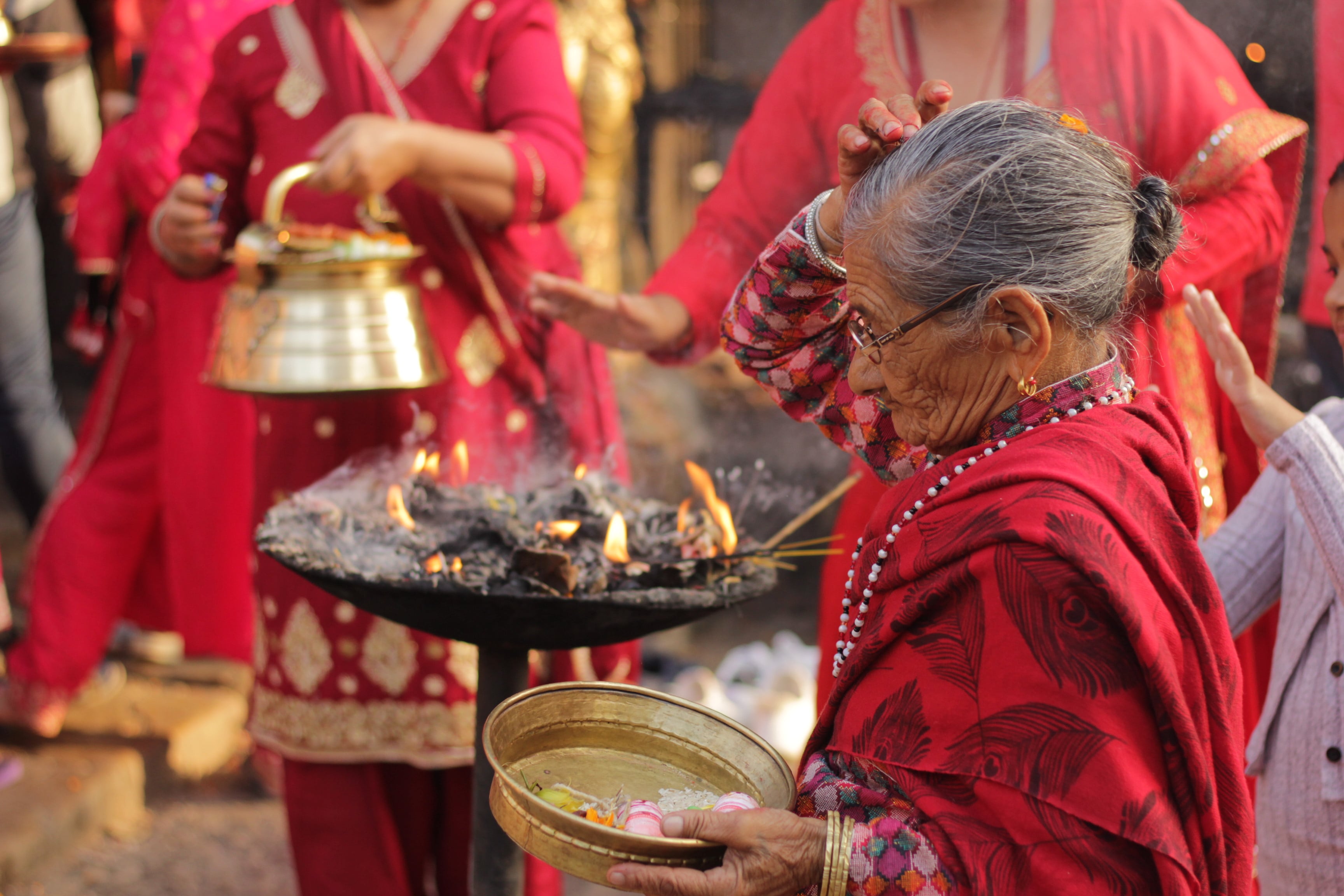
The next morning, we woke up early to see the Bagh Bhairav temple, where people brought offerings for the holiday Dashain.

That afternoon, I found myself squatting in front of a mortar and pestle in Ganga’s kitchen, grinding sour plums, garlic, and sesame paste into the sauce while Ganga bustled around the stove, frying seasonal vegetables and watching over simmering dal. We talked about everything—love, relationships, babies, and the expectations placed on women in different cultures. She felt like the older sister I never had, insisting I call her Ganga didi, a Nepali term meaning "older sister."
On the third day, we had our momo-making session. It was intimate, just me, Ganga, and other homestay guests. Squatting on the floor, we learned two different pleating designs for the dumplings. The work was tedious but somehow meditative. All of us sat together, chopping endless vegetables, talking, and laughing. We told jokes, sipped beers, and ate Nepali snacks while we did it. What struck me was how natural it felt, like cooking with family.
"Some of them say, 'I don't have to think about anyone when I want to buy gifts for someone,'" Aayusha told me. "And the women smile when they say, 'Now my husband asks me money.'" Sitting in Ganga's kitchen, watching her confidently lead our cooking session, I could see exactly what Aayusha meant.
What I didn't realize then was that this comfortable, homey experience was the result of careful planning and community collaboration. In just four months, since launching in July 2023, Kirtipur's momo experience had hosted over 1,100 travelers and brought in more than 1.6 million Nepali rupees (about USD 12,543)—equivalent to several years' income for many local families. At $15 per experience, it's well above the $2-3 you'd pay for momos in a local shop, but visitors aren't just paying for dumplings; they're investing in community transformation. It wasn't just about momos; it was about sitting in a Nepali kitchen, learning family recipes, and building connections through stories.

Between cooking sessions, we'd walk to the small market near her house. She'd explain the different vegetables, point out her favorite vendors, and share bits of neighborhood gossip. One afternoon, she took me to a local festival where people danced in traditional folk costumes. By my fourth morning, she knew exactly how I liked my chai and which cookies I preferred for breakfast, though she still insisted I drink hot water first—a habit I found myself keeping even after I left.
What I experienced in Ganga's kitchen was exactly what CHN and Planeterra had hoped for when they first approached the community. It was the women of Kirtipur who shaped the experience, choosing to share their momo-making tradition. CHN works with 36 communities across Nepal, impacting around 1,500 people in 352 households. When you pay $15 for a momo experience, 80% of the money stays in the community: 60% goes to hosts like Ganga, 20% funds community projects like street lighting and education, and the remaining 20% supports CHN’s operations. This simple system is transforming lives, enabling women to lead and support their communities.
These women aren't just earning money—they're becoming entrepreneurs. The COVID-19 pandemic hit Kirtipur hard, bringing tourism to a complete halt. But instead of giving up, these women regrouped. The changes ripple out beyond money. CHN encourages women to bring their male family members into the conversation. "They need to understand," Aayusha explained to me, "because it's a patriarchal society... if only women understand their own pain and only women understand how to get it, it's never going to end."
I saw this at work during the momo sessions. Kirtipur hosts two or three groups each week during high season, usually 10-15 people at a time. It’s not just about learning to cook—it’s cross-cultural conversations happening over chopping boards and steaming dumplings, a kind of exchange you don’t get in a restaurant.
From my perch on Ganga's kitchen floor, I watched how naturally she guided our session. The whole operation works like a well-oiled machine now, but it didn't start that way. Kabita Maharjan was one of those first five women who came together to launch this program. "Community tourism, for me, is working as a team," Kabita had told Aayusha. "If I had to do this alone, it wouldn't be possible, as I lacked experience hosting travelers. But as a team, we make it work."

This tapping into what the community wants is happening all over Nepal. Panauti, one of CHN's first communities, started with just one homestay. Now, it has 17. The network stretches from Far Western to Eastern Nepal, each place offering something different. But what ties them all together is the same spirit I found in Ganga's kitchen—this blend of tradition and progress, of keeping cultural practices alive while pushing for change.
They have some big partners now, including USAID, Planet Era (which works in over 100 countries), and local government bodies. But sitting here in Ganga's kitchen, it still feels wonderfully small and personal. When she reaches over to correct my momo pleating technique, laughing at my clumsy fingers, I don't feel like I'm part of some big international development project. I feel like I'm learning from a friend.
On my last morning, drinking that mandatory glass of hot water before my chai, I thought about what community tourism means. I remembered how nervous I'd been about the homestay. I’d never done one before, so I didn’t know what to expect. Would it be awkward? Would I be intruding? But here I was, four days later, getting a long hug from Ganga, promises to stay in touch, and one last cup of chai made exactly to my taste because Ganga had taken the time to learn my preferences.
That's what CHN has built—not just a network of homestays but a web of relationships. In Panauti, women run seventeen homestays where there used to be one. In Bardiya, families are offering wildlife experiences. In Kirtipur, women like Ganga and Kabita are turning daily cooking routines into cultural exchanges. Each place is different, but they're all built on this same simple idea: that everyone grows richer when we share our homes and stories.
Before I left, I thought of asking for Ganga’s momo recipe but decided against it. Without her fresh, hand-dried Nepali spices, it wouldn’t be the same. Perhaps that’s the essence of community tourism—some experiences are meant to stay in the moment.

Cargando...
Your Cart ()
No tienes ningún artículo en tu carrito.
You may also like
Subtotal:
Subtotal after discount:
Cargando...