
Search is currently unavailable. To use search functionality, please accept cookies in your preferences.
Replacing Combat Zones with Mountains
Finding my community with Veterans Expeditions.
8 minutos leer
Lauren Franks
Nov 11, 2025
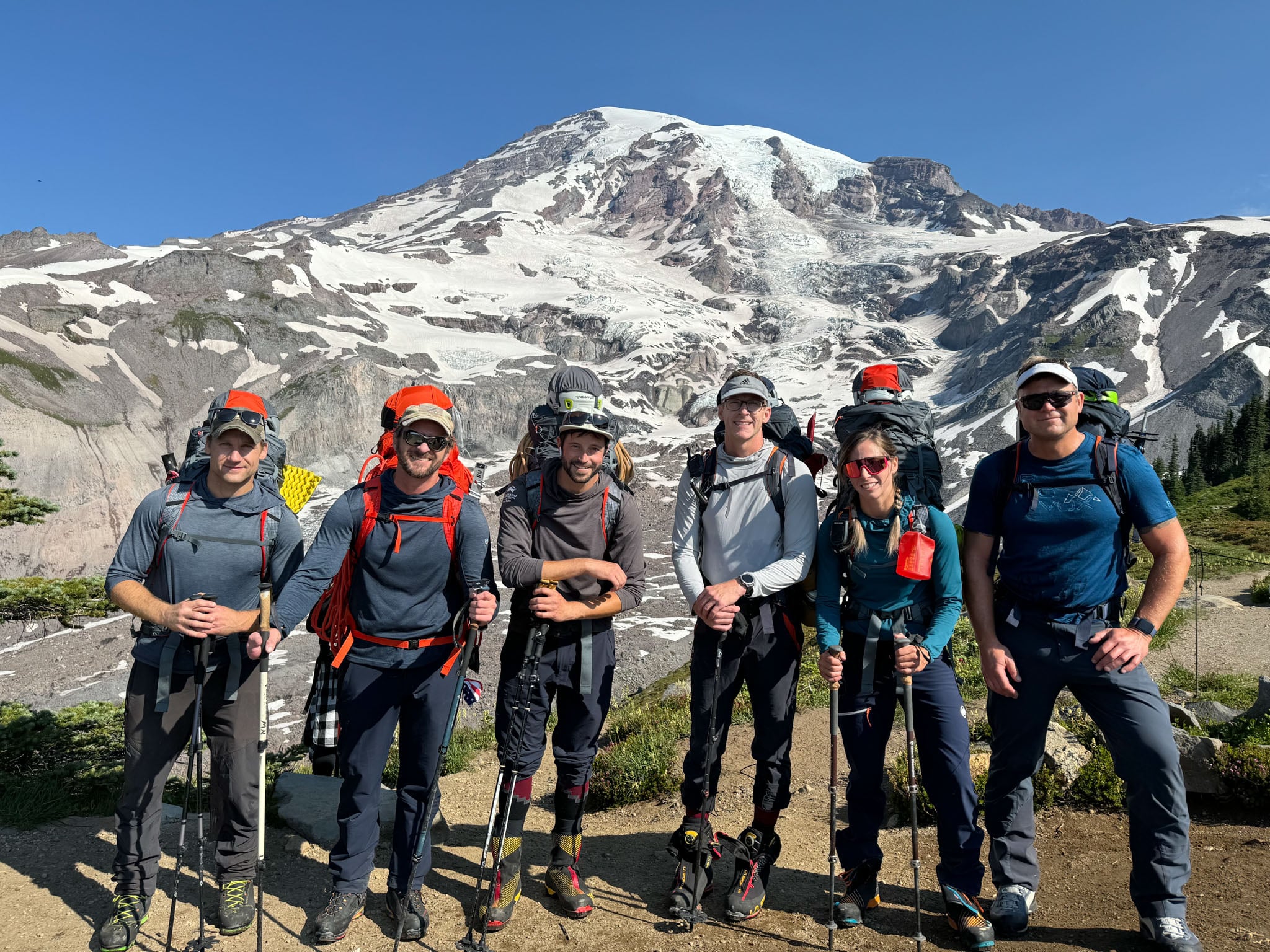
I looked up at the glacier and the distant summit ahead. Well, not the summit itself—I knew we couldn’t see that yet. My heart rate had to be a steady 160 beats per minute. My feet felt like they weighed thirty pounds each. The pack had dug so far into my hips that I knew it would leave bruises. Exhaustion was setting in, and we still had at least another 1,500 vertical feet to climb before reaching the top of Mount Rainier—plus 5,000 more to descend safely back to high camp.
The day before, we’d climbed 5,500 feet with fifty-pound packs to establish camp before our summit push via the Kautz Glacier. Our 2 a.m. departure felt like days ago, not hours. I needed more food and water, but I didn’t want to stop the team. Everyone was tired. If each of us paused for individual needs, our chances of reaching the summit would drop significantly.

We were a group of six—two rope teams of three. Nate and Brad were on my rope team. Nick, the founder of Veterans Expeditions, and two of the organization’s leaders made up the other team. I’d first met Veterans Expeditions a year and a half earlier on an ice climbing trip to Lake City, Colorado. By the end of that trip, I knew I’d found a group of people I could let my guard down with—people who understood my background and shared the same dark humor that comes from seeing a side of humanity most never will.
I felt the rope tighten, and looked up. Brad climbed at a steady pace while scanning for crevasses on the steep snow slope. I looked back at Nate, who noticed my pause and gave me a tired but encouraging smile—the kind that said, We’re all suffering together.
I turned forward again, kicked one crampon into the snow, then the other, again and again. I closed my eyes for a moment, and my mind flashed—to a different place, a different team, a different lifetime.

I opened them to the sound of my gunner’s voice: “I see missiles incoming.”
His voice was calm and even; though I knew he was controlling the rising panic. We were 10,000 feet over Al-Asad Air Base in Iraq. I was flying an AC-130W gunship with a crew of ten—my team. The first wave of Iranian theater ballistic missiles impacted numerous points across the air base.
There were thousands of military troops down there, to include our teammates and friends who had not had the ability to seek shelter before the missiles struck. We had no communication with them. My combat system officer and navigator furiously scanned the location of our compound with their sensors, desperate to see if it had been hit. We were already low on fuel. My copilot had been relentlessly working to coordinate a refueling tanker before we’d have to divert to Kuwait.
As another wave of missiles streaked across the sky and found their marks on the air base, my copilot finally reached a KC-135 tanker and secured a rendezvous location. If we didn’t leave for the tanker now, we wouldn’t have enough fuel to stay airborne.

Without even needing my direction, my crew executed duties as my copilot and I focused on prepping to rejoin with the tanker. My combat system officer maintained communication with multiple other ground parties to get updated reports. My navigator kept scanning and marking impact points, not only for our own knowledge, but for intelligence findings later. My gunners prepped our weapons and scanned for ground to air threats that could take our aircraft down. My flight engineer monitored the aircraft systems and balanced the fuel until we received more from the tanker.
I was tired—mentally, physically, emotionally. Fatigue dulled my focus, and I knew we had many more hours to go before landing. Not to mention finding somewhere to sleep at a place we had no intention of diverting to just a few hours before. My crew had to be exhausted too, but they operated as a well oiled machine without a single complaint. For them I knew I would keep rallying as long as it took to finish this mission, overwatch our base to ensure no ground attacks ensued, and get my team safely on the ground.
As I flew within a foot of the tanker to connect to our aircraft for refueling, I saw a third wave of missiles in the distance. I wondered if our friends were alive, I wondered what this meant for our community on a larger scale. We finished refueling, disconnected from the tanker, and began flying back towards Al-Asad. I glanced at my copilot. He gave me that same knowing smile—the one that said, We’re all suffering together.

I blinked and looked up. The summit of Rainier was closer now. I took in the people around me—Nate and Brad, both Marine infantry; Nick and Josh from Army Special Operations; Roger from Army Calvary. My team had changed. The mission had changed. The suffering had changed. But what hadn’t changed was being surrounded by amazing people I could lean on when exhaustion threatened to take over.

Today marks one year and two months since I left active duty. Mountains have replaced combat zones. Veterans Expeditions has replaced my crew members. We’re all still suffering together—but in this company, can I really call it suffering?
I don’t think so.

Veterans Expeditions is a veteran led, 501c3 chartered non-profit organization that began in 2010, to enhance the lives of our nation’s Veterans. Their mission is to empower veterans to overcome challenges associated with military service through outdoor training and leadership. Osprey supports Veterans Expeditions on our mission to build a more diverse and inclusive outdoor community and remove barriers to outdoor participation.
Photo Credit: Lauren Franks
Cargando...
Your Cart ()
No tienes ningún artículo en tu carrito.
You may also like
Subtotal:
Subtotal after discount:
Cargando...