
Search is currently unavailable. To use search functionality, please accept cookies in your preferences.
On the Rooftop of Africa's Mt. Kilimanjaro, Women Rule
When you’re standing atop Africa’s tallest peak, life’s everyday challenges suddenly seem surmountable. Just ask Exodus guide, Lucia Kivoi.
12 min read
Laura Kiniry
Mar 06, 2025
It’s no easy feat making the eight-hour trek pole pole (the Swahili phrase for “little by little”) from Barafu Camp to Uhuru Peak, the highest point on 19,341-foot-tall Mount Kilimanjaro. We’d begun our ascent at 11 p.m. the previous evening, following a long line of headlamps up the side of the dormant volcano while battling the effects of altitude, including headaches and (in my case) a stomach that was doing somersaults, for a chance to reach the summit. By the time we arrived at Stella Point—the 18,885 foot-high perch on the edge of the Kibo crater—I was thirsty, exhausted, and more determined than I’d been in a very long while.
“Do you want to keep going to Uhuru?” our head guide asked me.
“That’s my plan,” I said. I drank down a cup of tea, adjusted my poncho over my backpack, and set out slowly along the last 600 feet to the summit.
About an hour later, I stood at Uhuru Peak. A huge smile spread across my face as our guide and I hugged. While summiting Kilimanjaro was a first for me, our expedition leader had already climbed the mountain over 100 times. This was typical among guides on “Kili,” though there was one main difference between our particular leader and the bulk of others that we’d encountered over the last seven days: our guide happened to be a woman.

Born in nearby Arusha, the capital of Tanzania’s northern safari circuit, Lucia or“Lucy” Kivoi is known as “Lioness” for her role as one of the first female porters—and, later, guides—escorting groups to the top of Kilimanjaro. It’s a job that’s been male-dominated for centuries. In fact, even as recently as a decade ago, a woman working on the slopes of Kili was an extreme rarity. However, in her time on the mountain, Kivoi has not only helped pioneer the role of female porters and guides, but she’s also become something of a celebrity.
“Everyone knows you,” I pointed out, as Kivoi stopped to swap stories with yet another group of guides during our summit descent.
“I told you,” she said, laughing. “This mountain is my office.”
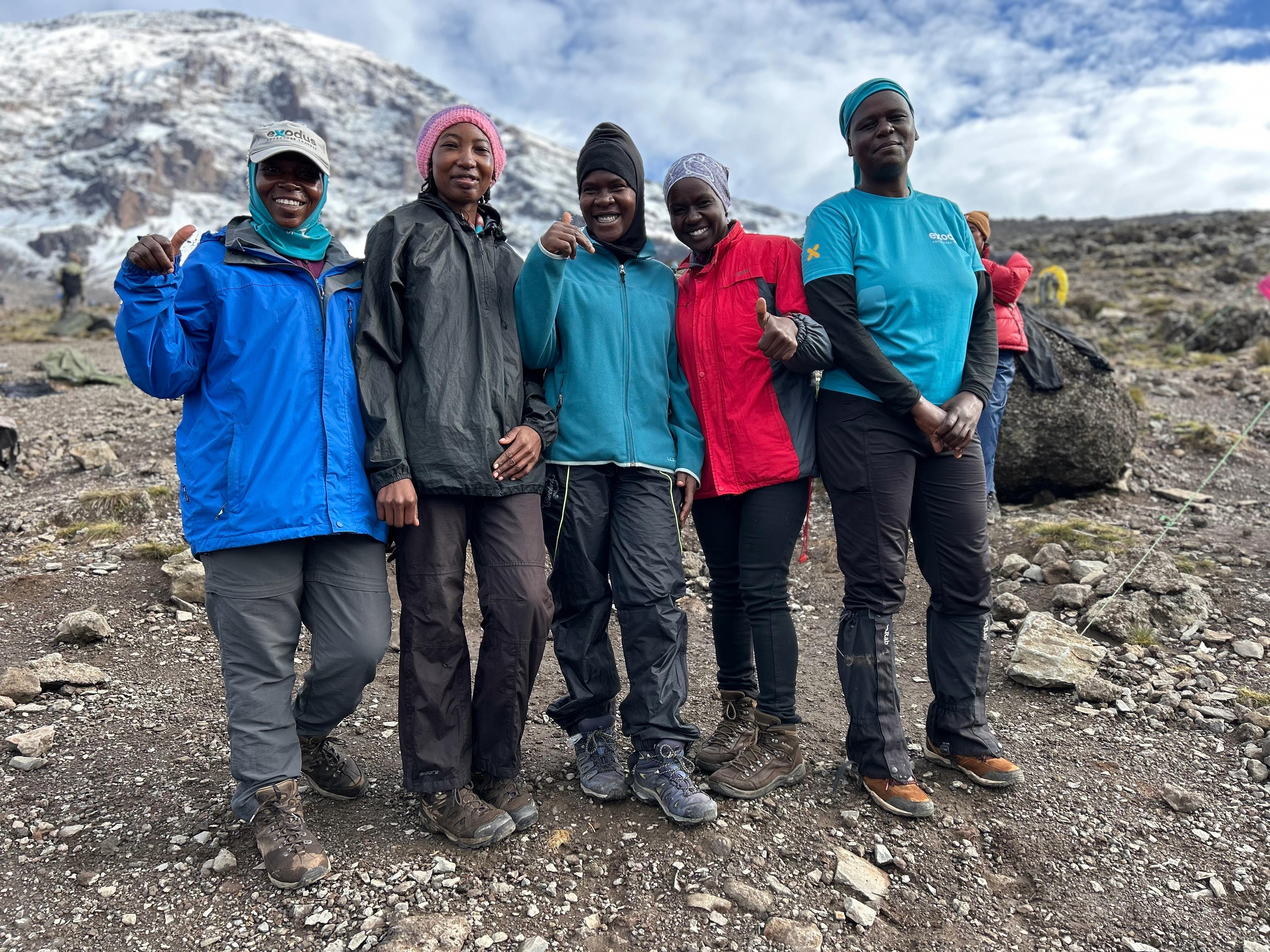
When I first decided to climb Kilimanjaro, it was doing so under the leadership of a woman that most appealed to me. Even today, women make up only 18 percent of the whole staff of Kilimanjaro, and we were lucky enough to have five of them—Kivoli, assistant guide Happyness Kipingu, and porters Joyce, Grace, and Shakira—on our 26-person Exodus Adventure Travels support team. While there aren’t enough women working in the industry to guarantee an all-female crew, companies such as Tanzania Horizon Safaris, Yugen Earthside, and Alpinistas Adventures also offer trips with female guides and/or porters. These roles provide women in Tanzania a stable source of income in a landscape that’s close and familiar, and offer many single mothers and widows a chance at economic security. But their literal trek to the top hasn’t been easy.
“The hardest thing has always been when the men don’t accept us,” said Kipingu, talking about the negative comments she's heard from male guides and porters since starting out as a porter in 2016. Things like, ‘females aren’t strong enough,’ or ‘women belong at home.’ “But what men can do, women can do as well,” she continued. This includes carrying as much as 20kg in gear up mountain—things like sleeping bags, mats, food, and tents, all packed in duffels that are often piled atop their heads. It’s a weight that’s checked regularly by the Kilimanjaro Porters Assistance Project (KPAP), a Tanzanian NGO on securing ethical treatment and fair wages for Kili’s expedition teams.
“Do female porters carry as much as male porters?" I asked Kivoli during one of our daily hikes.
“There are no ‘female’ or ‘male’ porters,” she responded. “On Kili, there are just porters.”


Kilimanjaro’s Lemosho Route
The day before I left for Tanzania I received a message from a friend: “Stay safe on that mountain,” it read, “but absorb its power and energy, and remember you’re a warrior.”
A warrior in the company of other female warriors, which is just how I like it. I had chosen Kili’s Lemosho Route, often considered the most scenic of the mountain’s seven established routes. This eight-day expedition through rainforest, heathered moorland, alpine desert, and snow-covered scree-fields (as well as the Barranco Wall, an 843 foot-tall rock scramble) offers trekkers the most opportunities to acclimate to the increasing altitude—an ascent of 12,451 feet.
Our small group consisted of five climbers in total, three women and a father and son team, ranging in age from 23 to 60. Although we all just met a day or two previously, we connected instantly. Our common goal: to summit Kili with the “Lioness” as our guide.

“Call me Lucia, or Lucy,” Kivoli told us before setting out from the Londorossi Gate on Kili’s northwestern slopes. “You can even call me “mama” if you like, because here on the mountain we are your family, and I am your mother.” Under Kivoli’s leadership, we spent mornings trekking through tree-filled landscapes where black and white colobus monkeys rested in the leafy branches and taking in open vistas across vast swaths of volcanic scree, and afternoons and evenings huddling in our mess tent for warmth. We’d dine on soups like cream of cucumber and plates of chicken, meat, and spaghetti—expertly whipped up by chef Danny—and sip on cups of hot chocolate and tea. All around the camp sites, white-napped ravens scavenged the grounds for food, while expedition teams boiled water for washing and drinking, set up tented latrines, and prepared for another day of hauling our belongings up to base camp so that we could start our final ascent.
Despite an especially rainy week, we occasionally caught sight of the evening stars, a mix of northern and southern constellations due to our position just below the equator. On a few nights when the clouds broke, the lights of Moshi City and Arusha even sparkled far below us in the distance. Although we could see them, these places and the rest of the world seemed like another planet entirely. Here on the slopes of Kilimanjaro, life was simple. That is, when I didn’t think about summit night or my damp sleeping bag or the queasiness of my stomach the higher in elevation we went. In the end, it was all just a part of the experience.


We were given a few hours to rest on summit night before our final climb, so I curled up in my sleeping bag, a freshly filled hot water bottle held snugly to my chest, and thought about something Kipingu had told me. “Our main goal on the mountain is safety,” she had said, “and then it’s helping our clients achieve their dream.”
Several hours later, when we were well into our ascent and my stomach had a mind of its own, Kipingu was right beside me—living up to her words. “You’ve come so far,” she whispered. “Don’t let this stop you.” I played that sentence over and over in my head as I continued pole pole, placing one foot in front of the other and never looking ahead or behind.
So much of that final push to the top remains a blur to me, but there’s one image that’s left an indelible mark on my mind: standing at the sign post at Uhuru Peak, and getting there under the guidance of some truly bad-ass women. It’s a moment that, for me, will always be unforgettable.

Working Towards Gender Equality
The Exodus Travels Foundation—a registered charity that offers financial support for community building and grassroots initiatives worldwide—oversees Tanzania’s Mountain Lioness Project. This initiative, which provides intensive three-week training sessions for local women who want to obtain their guide license, is named after Kivoi, who has pioneered the acceptance of female porters and guides on Kilimanjaro. As one of the first female-only programs of its kind in Tanzania, the project has provided sponsorship to dozens of women to train and qualify as Kili guides, teaching them first aid, outdoor emergency care and wilderness rescue; mountain ecology; mammal identification; and tour guiding techniques over a three-week period.
Learn more at www.exodustravels.com/us/foundation/mountain-lioness-project.
Loading...