
Search is currently unavailable. To use search functionality, please accept cookies in your preferences.
Laura Kiniry
Mar 21, 2025
Despite being one of Central Asia’s smallest countries, Kyrgyzstan is jam packed with both natural beauty and outdoor adventure offerings. Its 77,200 square miles are home to 13 national parks and 10 nature reserves, not to mention numerous mountain ranges (90 percent of its territory sits above 4,921 feet), widespread glaciers, and nearly 2000 lakes. This is a place where the nomadic lifestyle dates back thousands of years and traveling on foot is the typical way of doing things. It’s also an open-air playground that remains largely off of many travelers’ radars, meaning it’s still possible to have large pockets of wilderness mostly to yourself.
Recently, I had an opportunity to experience Kyrgyzstan’s incredible outdoor offerings firsthand, and learned that while getting around the country on your own is doable with the use of public transit (such as marshrutka minivans), sideroads are often completely unpaved and travel can be incredibly slow going.
Thankfully, big cities like Bishkek, Osh and Karakol all serve as bases for active adventurers, with spots to arrange individual guides and/or join guided group treks, as well as rent tents, backpacks, and rain gear.

There’s also the country’s Kyrgyz Community Based Tourism Association (KCTBA), which provides travelers with a way to tap into local natural and recreational resources countrywide—from overnight yurt stays to multi-day treks over mountain passes—while employing rural residents in the process.
Here’s what I discovered are some of Kyrgyzstan’s top treks and natural wonders and the best spots in the country for starting your own outdoor explorations.
Karakol
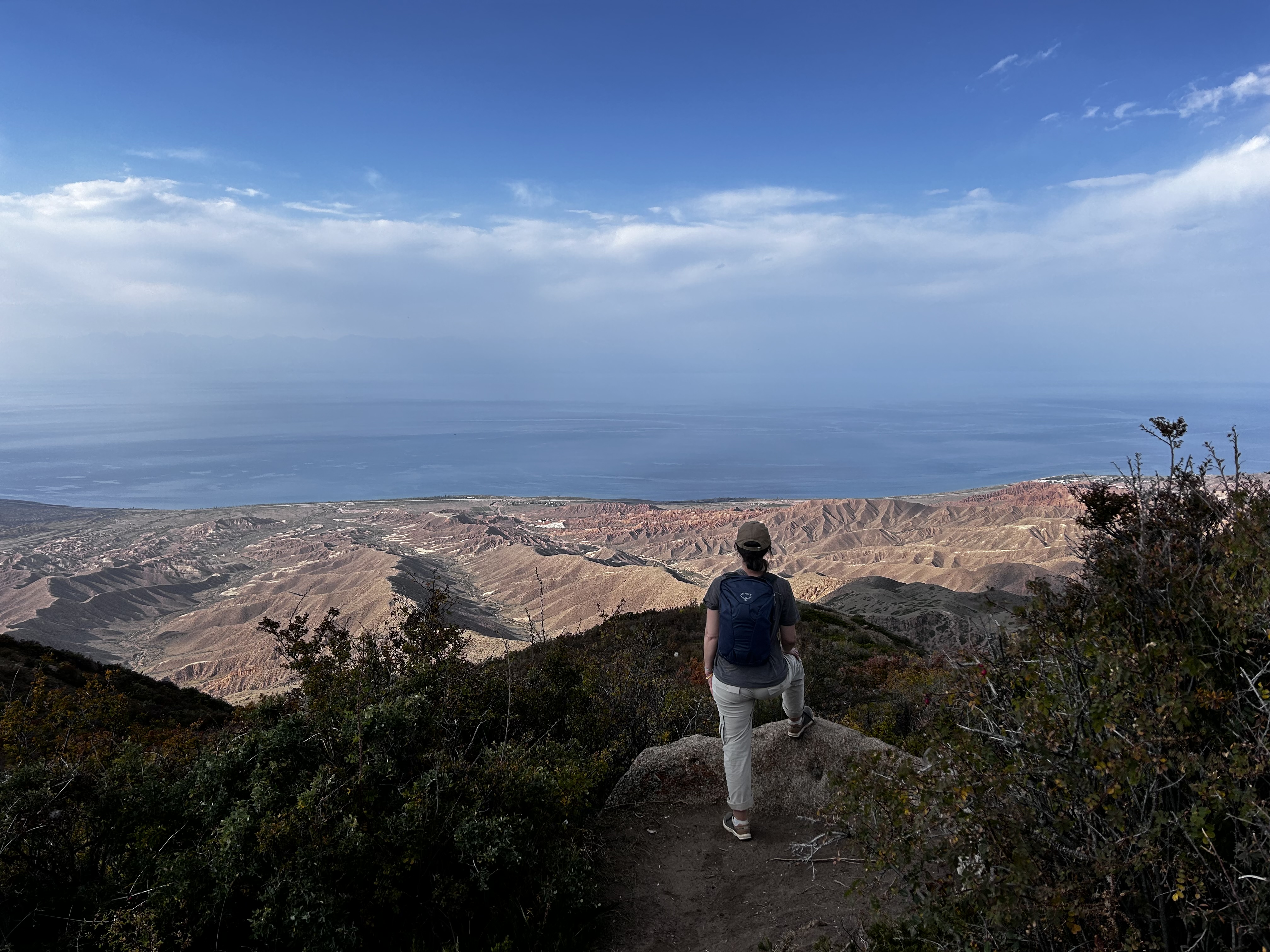
A city in eastern Kyrgyzstan’s Issyk-Kul region known for its late 19th century Russian architecture and Dungan culture—a people of mixed Chinese, Muslim, and Russian heritage with their own history and culinary traditions—Karakol is also considered the country’s “adventure capital.” It serves as a gateway to both the snow-capped Tien Shan mountains and the eastern shores of Issyk-Kul lake, a 5,272 foot high in elevation, deep-blue beauty that at 2,408 sq miles is the second-largest mountain lake in the world behind South America’s Lake Titicaca and was once a natural stopping point along the famous Silk Road.
Kyrgyzstan’s popular 34-mile Ala-Kul trek begins in the Karakol Valley, a multi-day hike that meanders through green meadows and conifer forest, ascending its way up to Ala-Kul lake, an extraordinary body of turquoise water perched among glaciers and mountain peaks. There’s also the Ak Suu Transverse trek, a challenging 68-mile span from the riverside village of Jyrgalan to the sheer red cliffs of Jeti-Ögüz, known as the Seven Bulls (and one of my favorite spots in the region). Over eight days the journey takes you past numerous waterfalls and lakes, including Ala-Kul, across multiple mountain passes, and even encounters some hot springs. What’s more, there’s a new network of yurts for lodging along its entire route.

If you’re after a hike that’s shorter, try the eight-mile trek to wild hot springs (perched 8,000 feet in elevation). The route follows the Arashan River in Kyrgyzstan's Altyn Arashan Valley, approximately 19 miles from Karakol, and begins in the town of Teploklyuchenka (also called Ak-Suu). Or explore the sculpture sandstone landscape of Skazka Canyon, along Issyk Kul southern shore. It’s often referred to as Fairy Tale Canyon for its narrow passages and towering formations, formed by wind and water over thousands of years.
About 10 miles east of Karakol, Ak-Suu Hot Springs is the perfect place for soothing your tired muscles. Its outdoor thermal pools range in temperatures from 90 to 113 degrees Fahrenheit, and you can also opt for an ice bath in the neighboring Arashan river, complete with mountain views.

Osh
Osh is Kyrgyzstan's oldest city, a “capital of the south” that’s within close proximity to the country’s border with Uzbekistan. Along with being southern Kyrgyzstan’s outdoor hub, Osh serves as an entry point to the nearby Alai Mountains, a range that’s brimming with alpine meadows and dramatic summits.
Some of the closest hikes to the city exist in the Kichik alay, or lower Alai mountains. These include the ancient nomad trails of Kyrgyz Ata National Park, about 25 miles south of Osh, which meander among cool juniper forests and jailoos (summer pastures). A bit further afield near the village of Sary Mogul is Peak Lenin, a 23,405-foot-tall mountain that sits on the Kyrgyzstan–Tajikistan border. Summiting the peak itself takes ample time and pre-planning, but the 4.4 trek from Peak Lenin Base Camp to Traveller’s Pass—a 13,615-foot-high perch offers supreme views of the peak and its surrounding glaciers—is doable in an afternoon.

Tucked away at the foot of Babash Ata mountains off the main Osh-Bishkek highway, the Uzbek village of Arslanbob (it’s located just 43 miles east of the Uzbekistan border) is home to the largest wild walnut forest on the planet. It’s also starting point for the Holy Lakes trek, a moderate four-day expedition over two mountain passes and changing landscapes that morph from lush open meadow to azure-colored lakes, which offers a prime chance to encounter local shepherds en route.
Bishkek
Bishkek is Kyrgyzstan’s true capital. It is a heavily-trafficked urban center that can be overwhelming at times, but is also thankfully in close proximity to the Kyrgyz Ala-Too mountains (a western spur of the Tien Shan mountains) and Ala-Archa National Park. The latter is located just 22 miles south of the city, and is brimming with stunning, rocky gorges, glacial canyons, and pine forest, as well as hikes that include a short, steep three-mile trek to Ak-Sai waterfall and a longer climb to the foot Ak sai Glacier (there’s an onsite hut for overnighting). Bishkek is also an easy day trip to Konorchek Canyons, dubbed the “Valley of Castles” for its otherworldly, orange-and-red hued rock formations.
Equidistant between Bishkek and Karakol (about a four hour drive from both), Song-Kol Lake was one of the most magical spots I visited on my Kyrgyzstan expedition. Situated at an elevation of 9,895 feet, it’s among the highest lakes on the planet. This alpine stunner is best accessed either via horseback or on foot from 8,740 foot-high Kyzart Pass, climbing to the top of 10,042 foot-high Chaar Archa Pass before making its way downward. There are plenty of yurt camps for overnight stays, and the stargazing here is incredible.


In the End
However you decide to experience Kyrgyzstan, now is the time to do it. Just get ready to be amazed!
Loading...