
Search is currently unavailable. To use search functionality, please accept cookies in your preferences.
The Choice
Setting a women's self-supported FKT on the Appalachian Trail.
8 min lire
Lyla “Sugar” Harrod
Oct 17, 2025
Lyla “Sugar” Harrod is a sober, queer, trans woman and professional thru-hiker. As the first known trans woman to complete the Triple Crown of long distance hiking, she has used her platform to advocate for queer and trans representation and equity in the outdoors. In 2024, Sugar pioneered the “Divide to Crest Route”, a 3,000 mile backcountry route from the Mexican border in New Mexico to the Canadian border in Washington. She founded a free mentoring program for first-time queer and trans thru-hikers called “TrailQTs” in 2023.
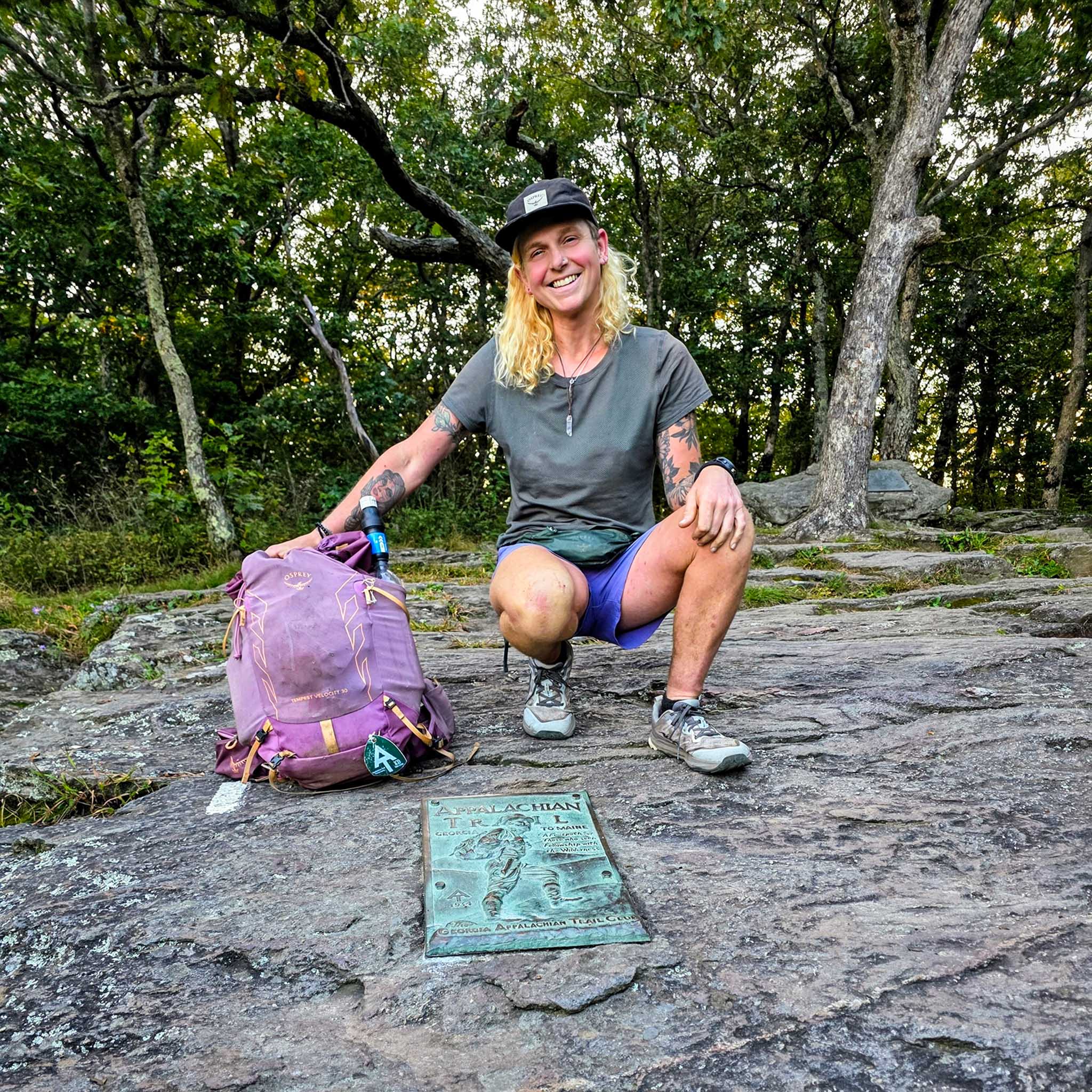
“I’m tired, and my feet hurt.” Pretty much the only thought running through my head when I finally reached Springer Mountain, the southern terminus of the Appalachian Trail just before 5 AM on September 18th. My friends who had hiked up to meet me at the terminus were cheering and feeding me celebratory treats, but my body was too worn down in the moment to appreciate what I had just accomplished … hiking the entire 2,198 miles of the Appalachian Trail in 52 days, 18 hours, 37 minutes. A new women’s self-supported speed record, known as a Fastest Known Time (FKT).
While my feet do still hurt, I’ve had some time to process and rest. My days on the Appalachian Trail this summer were some of the most physically and mentally demanding of my life, and I’ve come out a stronger hiker, athlete and human as a result.

People ask me “How do you do it?” Choosing to push forward day after day, through challenging, often technical terrain is not a one-time decision, it’s an ongoing series of decision points, with the core question being “Do I want this enough to continue on?” For me, this question, which I called “The Choice” reigned foremost in my thoughts in the first quarter of the trail through Maine, New Hampshire and Vermont. My body was doing its best to acclimate to the seemingly neverending high mileage, high elevation change days. Mentally I endeavored to focus only on the current day, unable to fathom the distance I had yet to go and the struggle still left to endure. Each time “The Choice” reared its head, I found myself digging into a reserve of mental strength, and leaning on all the positive feelings and moments of peace, beauty and connection I experienced on trail … a beautiful sunset, a chance encounter with wildlife, a chat over juicy peaches at a farm stand with a fellow thru-hiker.

As my resolve steeled, I found “The Choice” became easier and easier. My response to it operated like a muscle, and just as my trail legs strengthened as the miles progressed, so did my ability to push through any thoughts of stopping. By the end of New England, “The Choice” didn’t feel like a choice at all anymore. I was committed to see it through to the end, whether I got the FKT or not.
But “The Choice” didn’t end when I stepped off the trail. Hiking teaches me how to face challenges, but my bigger challenge is living openly as a trans woman and fighting for my community. That’s not something I get to set down at the end of the day.
When people ask me again, “How do you do it?” I think about “The Choice” in a different way. Every day I face harsh rhetoric, bullying, and news that my rights—and the rights of other trans people—are under attack. Unlike hiking, I don’t get to decide whether I want to keep going. I have to keep going. This is about survival.

The first headline I saw after finishing my hike was our president's son claiming trans people are more dangerous than al-Qaeda. The ignorance and hate in that statement shows just how deep the misinformation runs in this country.
That’s part of why I chose to take on this high-profile trail record attempt. It wasn’t only about testing myself physically—it was about raising awareness, showing that trans people are real, valid, and human. Too often, people don’t think about these issues unless it touches their own life. I wanted to make them stop and ask questions.

There are also many misconceptions about trans women. Some think we’re just men pretending to be women. That isn’t true. The way our bodies develop comes from hormones like testosterone, estrogen, and progesterone. Cisgender men and women have different balances of these hormones, which affect everything from physical traits to emotions.
For many trans people, including me, hormone replacement therapy aligns our bodies with our gender. I’ve been on hormones for over seven years—my hormone levels are the same as a cisgender woman’s. In fact, a study performed using the military physical fitness assessment and published in the National Library of Medicine(S'ouvre dans une nouvelle fenêtre) shows that after a couple of years of hormone therapy, trans women don’t have any athletic endurance advantage over cisgender women.

Still, no amount of science will convince everyone. Many have been fed propaganda that makes them see trans people as less than human.
As a trans woman athlete, I receive hateful messages simply for showing up and chasing my dreams. But just like on the trail, I face “The Choice”: Do I want this enough to keep moving forward, despite the hate? My answer is yes. That decision was made long ago.
Setting this record on the Appalachian Trail was a culmination of years of hard work, countless days and nights of discomfort and sacrifice all in service of connecting with people and nature, following my heart, and encouraging others to do the same. My time on that narrow, rocky, winding path through the Appalachian Mountains reminded me and reinforced my decision to press on, keep my heart open, and my chin up. “The Choice”—to hike, to speak up, to live authentically—is my way of saying I will not be stopped. I will not be silenced. Here’s to the next adventure.
Lyla’s Fastest Known Time page(S'ouvre dans une nouvelle fenêtre)
Follow my adventures on Instagram(S'ouvre dans une nouvelle fenêtre)
Read More About Lyla's FKT Preparation(S'ouvre dans une nouvelle fenêtre)

Photo Credit: Lyla “Sugar” Harrod
En cours de chargement...
Your Cart ()
Votre panier est vide.
You may also like
Sous-total :
Subtotal after discount:
En cours de chargement...