
Search is currently unavailable. To use search functionality, please accept cookies in your preferences.
Have Gear (and Spirit), Will Ride
Take a journey with one of Bikepacking Roots' BIPOC Bike Adventure Grant recipients.
10 minutos leer
Chris Case
Nov 28, 2025
Bikepacking Roots(Se abre en una nueva ventana) is excited to launch the 4th cycle of their BIPOC Bike Adventure Grant(Se abre en una nueva ventana). The grant aims to reduce barriers to bike adventure for Black, Indigenous, and People of Color and has awarded 33 grants totaling more than $100,000 in cash and gear donations since its inception in 2020, making it the largest and longest running program of its kind.
Community leaders who have bikepacked before and have experience leading groups, and/or are interested in gear library development and support are encouraged to apply. Bikepacking Roots hopes to award between 6-12 grants for this cycle, each with cash awards of up to $2,000, plus generous in-kind gear donations from a number of business partners.
Applications must be received by no later than December 15, 2025. Applications will be reviewed by a panel of BIPOC adventure cyclists, and recipients will be notified by February 2026.
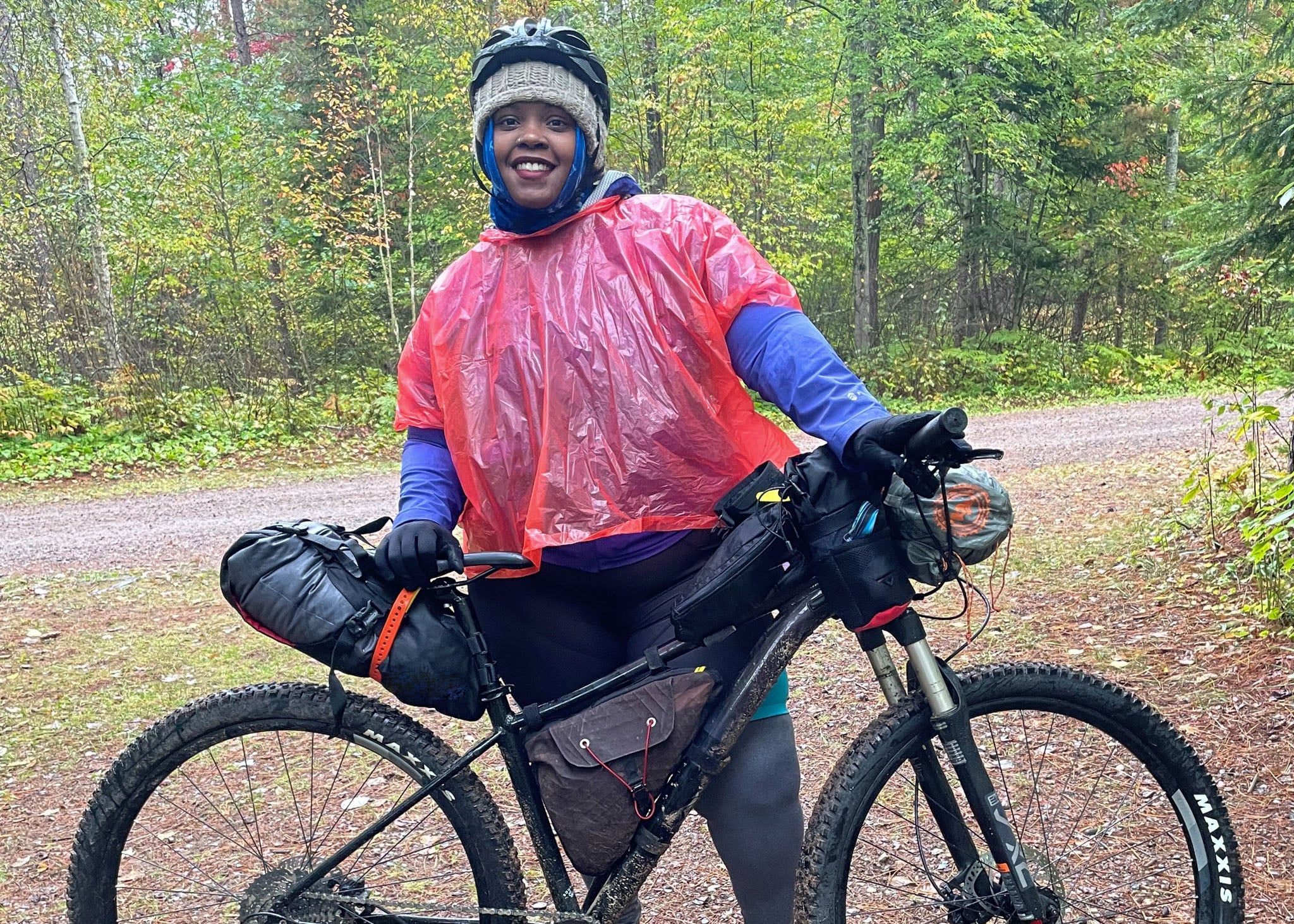
Chanel Mitchell is a teacher, in more ways than one. She’s learned throughout her career that she can deliver information in a way that resonates with those with little knowledge of a subject.
In July 2025, her subject was bikepacking, something she has taken up in recent years to build community and encourage more BIPOC individuals to expand their horizons.
So Chanel, 37, gathered 12 individuals from across the country—ranging in age from under 10 to over 60—and set her sights, and theirs, on Missouri’s Katy Trail, at 240 miles, America’s longest “rails-to-trails” route.

After receiving new gear from Osprey as part of Bikepacking Roots(Se abre en una nueva ventana)’ BIPOC Adventure Grant, everyone shared a first experience on this trip. Many marked off bucket-list items and others started drawing up their next adventure. The Katy Trail proved to be the perfect introduction to more bikepacking adventures—and the perfect opportunity for Chanel to be an evangelist for and a teacher of a sport she knows can open doors.
It wasn’t long ago that Chanel was, herself, learning from others and walking through that door.
Chanel’s bikepacking roots
Chanel took her first bikepacking trip with Bikepacking Roots Adventure Grant’s coordinator Devin Cowens and Brooke Goudy just a few years ago. They completed a three-day trip to Wisconsin’s Chequamegon-Nicolet National Forest. Ever since, she’s been building networks and working to encourage more BIPOC individuals to travel by bike.
For the past three years, Chanel has made a concerted effort to increase individuals' interest in riding; she’s well aware that this an area in need of increasing representation. After receiving the grant, she knew the Katy Trail would be the perfect first endeavor due to its accessibility, though she also knew that few BIPOC individuals have gotten to experience it due to the lack of educational resources, camping gear, and safety concerns along the trail.
Her role—always teaching—was to make the route doable and exciting, breaking it down so that people felt accomplished and proud after each day’s ride. There would be lessons on how to pitch a tent, pack bags, and, as simple as it seems, how to enjoy the outdoors.

Her vision was to start small, and eventually grow the number of BIPOC folks—to build a community—large enough in numbers to be able to venture outside of St. Louis without fear. Skills, tools, and resources to bikepack—and change lives, breaking the status quo of what cycling and adventure riding look like.
Three days of adventure
In July 2025, the band of 12 passionate cyclists from Wisconsin, California, Chicago, Alabama, Oklahoma, and Missouri united in the spirit of exploration and camaraderie to take on 110 miles of the Katy Trail. It would be a transformative three-day bikepacking journey on the longest developed rail-trail in the country.
Their adventure began with an inspiring Amtrak ride from St. Louis to Jefferson City, Missouri. On Day 1, they departed from the State Capitol and rode toward Portland, where they were warmly welcomed with hot showers and a bar and grill—an invitation to rejuvenate after their first leg of 35 miles.

Day 2 brought its challenges, as some cyclists skillfully dodged rain showers, seeking refuge in nearby tunnels, while others bravely pedaled across sun-drenched fields for 50 miles.
And on their final day, they triumphantly conquered the last 26 miles to arrive in St. Charles, greeted by the uplifting applause of a waiting cheerleader.
Q&A with Chanel
We caught up with Chanel to better understand what it meant to her, and to her fellow travelers, to complete this journey.

What is your personal highlight of the trip?
Chanel: So many first opportunities. I rode with many people that had never traveled to St. Louis, so that was a highlight. So many people were able to do a bucket list thing. There were so many first experiences for people that had never bike camped. Then there was the first time taking bikes on a train. Then getting people to experience their first time loading their bike, unloading their bike, preparing to ride loaded, preparing to eat camping food. All of it. Those are first-time experiences that are just tremendous moments that people don't always capitalize on that are huge, because it makes or breaks the experience of wanting to return, right?

Will there be a lot of second trips for people?
Chanel: Yes! While we were on the Katy Trail trip, we started talking about “what's next?” And so we talked about RAGBRAI, traveling for seven days, of course. Ms. Keisha, from Wisconsin, recognized the logistics of what I had to put together. And she was like, "You need a bigger team." And she was like, "You need a team to think about the things that you can't think about." And on the train ride, we started to talk about where were opportunities for us to reconnect and try again. So, then Ms. Lisa, out of California, said, "You guys should come to Cali and ride. There's a 40-acre private property that they're opening up. It’s BIPOC run and affiliated, and they're now starting to do group rides”
So, after the trip, most people were talking about, "I want to do this again. Where is our next trip?" They were like, "Are we going to have an annual? Run it back?" And I was just like, "Yeah, I guess we could, you know? If you guys are gonna come and do the legwork, I would definitely run this back, fix all of the issues or little hiccup things that I didn't think about or consider in the process of developing the trip.”

For those kids that were on this trip, what do you think it means for them to, first, do something like this, and second, do it with family members?
Chanel: I know it's a personal shared experience for Jehan, a Black young girl, to be amongst another Black young girl riding. This was Jehan's first, longest gravel ride, and she rode both days back to back, and she carried her luggage. I actually have a very touching video: we're almost to the 50 mile mark, which was our longest day, and the cheers… I was just asking her, “What is your word that’s gonna carry you?” And she just kept saying, "Awesome." And so, every time that it just got to that point where she was just like, "I can't," I was like, "You are awesome. Remember that you said that this was what you wanted, that you're overcoming. You are doing hard things. You can do hard things."
Photo Credit: Chanel Mitchell
Cargando...
Your Cart ()
No tienes ningún artículo en tu carrito.
You may also like
Subtotal:
Subtotal after discount:
Cargando...